
A lot of internal knowledge problems look small until
they start slowing people down. A new hire cannot
find the current onboarding guide. A manager keeps
explaining the same approval process. A team follows
an old workflow because the updated version sits in a
private document. Training exists, but people still
complete the same task in four different ways.
For KM teams, that is the real work. The goal is not to keep adding pages to a knowledge base. The goal is to make knowledge easier to collect, easier to trust, and easier to use when someone is trying to get work done.
That takes more than tidy folders. It takes a working system for turning scattered expertise into clear documentation, useful training, and internal processes people can actually follow.
Start by collecting better source material
Weak documentation usually starts before the writing begins.
If the source material is thin, rushed, or scattered across messages, the finished guide will feel the same way. It may explain the basic steps but miss the exceptions. It may describe what happens, but not who owns each part. It may sound clear to the subject matter expert and still leave a new employee guessing.
KM teams can avoid a lot of rework by treating knowledge capture as a separate stage.
Instead of asking someone to "send over the process," ask for the pieces that make the process usable. A good intake should pull out the trigger, owner, tools, approvals, common mistakes, exceptions, and update cycle.
A simple capture brief might ask questions like these.
- What starts this process?
- Who owns the decision or final approval?
- What tools, files, forms, or templates are involved?
- Where do people usually get stuck?
- What changes when the case is unusual?
- How often does the workflow need review?
That kind of structure helps experts share what they know without dumping a messy document into the KM team's lap.
A tool like Content Snare can fit here when teams need a cleaner way to collect documents, answers, and internal inputs from different people. For KM work, the benefit is less about gathering files and more about reducing the loose, forgettable back and forth that makes documentation harder than it needs to be.
Write for the person using the process
Many internal documents are written from the expert's point of view. That is why they often feel accurate but hard to use. The person reading the guide may not know the system, the team language, or the reason behind each step. They may be under time pressure. They may be trying to complete the task for the first time while a customer, manager, or colleague waits for an answer.
That changes how the document should be written.
A useful process page should explain what the person is trying to do, when the process applies, what needs to happen first, and what a good result looks like. The writing should be plain enough for someone outside the team to follow, but not so shallow that experienced employees have to chase missing details.
Good KM documentation often works in layers. The first layer gives the quick path. The next layer explains the steps. A deeper layer covers exceptions, edge cases, and ownership.
That structure keeps the page readable. It also respects the fact that not every reader needs the same depth at the same moment.
Connect documentation with training
Training and documentation often live in separate systems. One team owns the knowledge base. Another owns courses. Another owns the process itself.
Employees do not care about those boundaries. They just need to learn the task and do it correctly.
KM teams can help by building documentation that is easy to reuse in training. A clear process overview can become part of onboarding. A checklist can become a practice exercise. A set of common mistakes can become a short refresher lesson after the first month on the job.
This matters for recurring training needs such as compliance updates, system rollouts, customer handoffs, quality checks, and manager onboarding. If the source documentation is clean, the training team is not rebuilding the same material from scratch every time.
For organizations running structured learning programs, training administration software can help manage the operational side of that work. Sessions still need scheduling. Participants need tracking. Reminders need to go out. Certificates, attendance, and completion records need a reliable home.
KM teams may not run those systems directly, but their content feeds them. When the knowledge base is current and written in reusable pieces, training becomes much easier to maintain.
Make processes easier to follow in the moment
A process can be documented and trained, then still fail in daily use.
That often happens because the guidance is too far away from the work. Someone learns a workflow during onboarding, then needs it again three weeks later inside a tool they barely remember. If the guide is long or hard to find, they may ask a coworker, guess, or build their own shortcut.
For software based workflows, written instructions are useful, but screenshots and interactive guidance can remove a lot of friction. People often need to see the action, not just read the step.
That is where Supademo can support internal process adoption. KM or enablement teams can create walkthroughs that show employees how to complete common workflows inside the tools they already use.
This works well for approval requests, CRM updates, reporting steps, customer handoffs, account setup, or any task where the screen matters. The best walkthroughs stay narrow. One task. One user need. One clear outcome.
A broad tour of an entire system rarely helps much. A short walkthrough that shows exactly how to submit a request or update a record is far more useful.
Keep ownership visible
Knowledge gets stale when nobody is clearly responsible for it.
A process changes, but the guide stays the same. A form gets replaced, but the old link remains live. A team adjusts its workflow, but the training still shows last year's version.
KM teams can reduce this by making ownership part of every major knowledge asset. Each process page should have a named owner, a review date, and a simple way for employees to flag a problem.
The owner does not always need to be the KM team. Often, the subject matter expert should own accuracy, while the KM team owns structure, publishing standards, and clarity.
That split works well. Experts keep the details honest. KM teams make sure the knowledge stays readable, findable, and consistent.
Review timing should match risk. A compliance workflow may need a quarterly check. A low risk reference page may only need review twice a year. A tool walkthrough should be checked whenever the software changes.
Watch how people actually use the knowledge
Publishing a page is not the end of the work. KM teams need to know whether the guidance is helping. Page views can offer clues, but they can also mislead. A heavily viewed page might be useful. It might also be so confusing that people keep coming back because they cannot get what they need the first time.
Better signals come from daily friction. Repeated questions. Slow onboarding. Missed steps. Search terms that lead nowhere. Training completion with the same mistakes still showing up afterward.
Those signals tell the KM team where the system needs attention. Maybe the answer exists but uses the wrong language. Maybe the process is documented but not connected to training. Maybe the guide is clear, but the workflow itself has too many awkward handoffs.
The strongest KM teams treat these signals as feedback, not failure.
Build the loop, then keep it moving
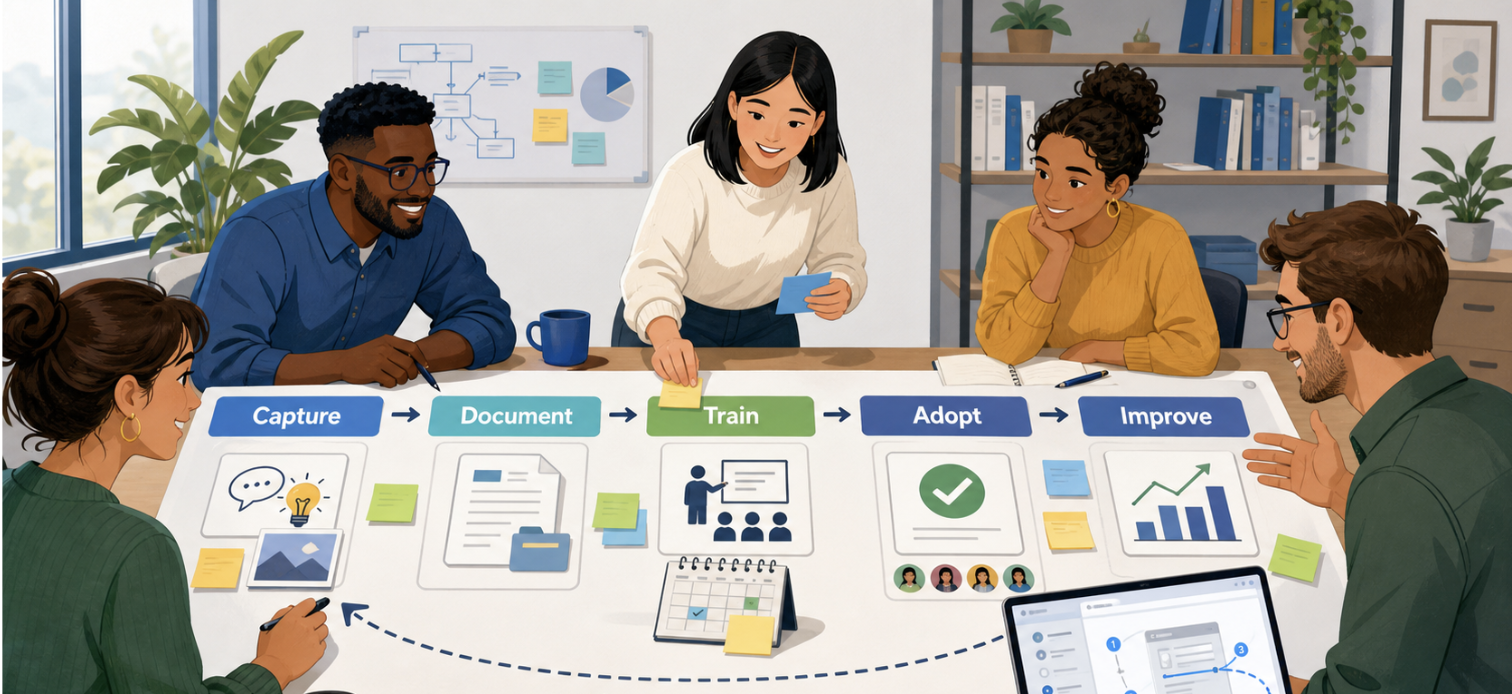
Good KM work has a rhythm. Teams collect knowledge from the people closest to the work. They turn it into clear documentation. They reuse it in training. They support adoption with guidance people can follow during real tasks. Then they refine the system based on questions, errors, and feedback.
That loop is what keeps internal knowledge alive.
For KM teams, the opportunity is practical. Help people find the right answer faster. Help new employees learn without drowning in scattered documents. Help process owners keep guidance current. Help the business stop relearning the same lessons every quarter.
A knowledge base can store information. A strong KM system helps people use it.
____________________


.png)
.png)
.png)
.png)