

Last week, I had one of the most stressful travel experiences in a long time. My flight got cancelled just a night before the actual travel.
By the time I checked other flights the next morning, every seat was either gone or priced sky-high due to the sudden rush of passengers scrambling to rebook.
Standing in that moment — trying to make sense of the chaos — one thought kept circling in my mind:
How did such a predictable disruption catch a major airline unprepared?
As a Knowledge Manager, I couldn’t help but analyse the situation through a KM lens. What I experienced wasn’t just a cancelled flight — it was a direct outcome of missing KM structures, weak cross-functional alignment, and the absence of institutional learning.
1. Forecasting Failure: Where Was the Knowledge of Patterns?
Airlines operate with cycles, trends, and historical patterns. Crew-rest rule changes, seasonal peak loads, airport congestion — all of these are known well in advance.
Yet IndiGo ended up cancelling flights due to crew-rostering gaps that could have been predicted months, if not years, earlier.
A strong KM approach would have enabled:
- analysis of past disruptions
- modellng of “what-if” stress scenarios
- predictive rosters for new regulations
- early indicators for staffing gaps
All of which should have triggered corrective actions before passengers like me faced last-minute chaos.
2. Breakdown in Knowledge Sharing & Cross-Functional Awareness
The most visible failure wasn’t the cancellation — it was the confusion that followed. This is exactly what happens when operational intelligence is trapped in silos.
With a KM-driven cross-functional flow:
- Scheduling
- Crew Management
- Ground Operations
- Customer Service
- Airport Teams
...would all operate with real-time, shared visibility. Instead, the information trickled down in fragments — too late, too inconsistent, and too chaotic.
3. Missing Documentation & Regulatory Readiness
Crew-rest regulations didn’t appear overnight. Airlines had enough time to redesign rosters, plan hiring, and adjust schedules.
This requires:
- Documented compliance workflows
- Readiness checklists
- Workforce planning triggers
- Integrated planning reviews
The crisis revealed clear gaps in structured documentation and the absence of a centralised KM-led compliance calendar.
A strong KM system would have connected planning, rostering, hiring, and communication — all aligned with regulatory timelines.
4. Incident Response Without a Playbook
During the disruption, there was no cohesive plan or customer communication framework. No mention of how and when refund will be issued, no support calls of how they will assist in helping with alternate travel arrangements as their moral responsibility for leaving passengers stranded.
A mature KM-led Incident Response Playbook would define:
- proactive alerts
- rebooking protocols
- customer-handling guidance
- baggage coordination steps
- escalation workflows
This would have ensured passengers were supported with clarity and care — not left navigating the chaos alone.
How KM Can Transform Aviation Reliability
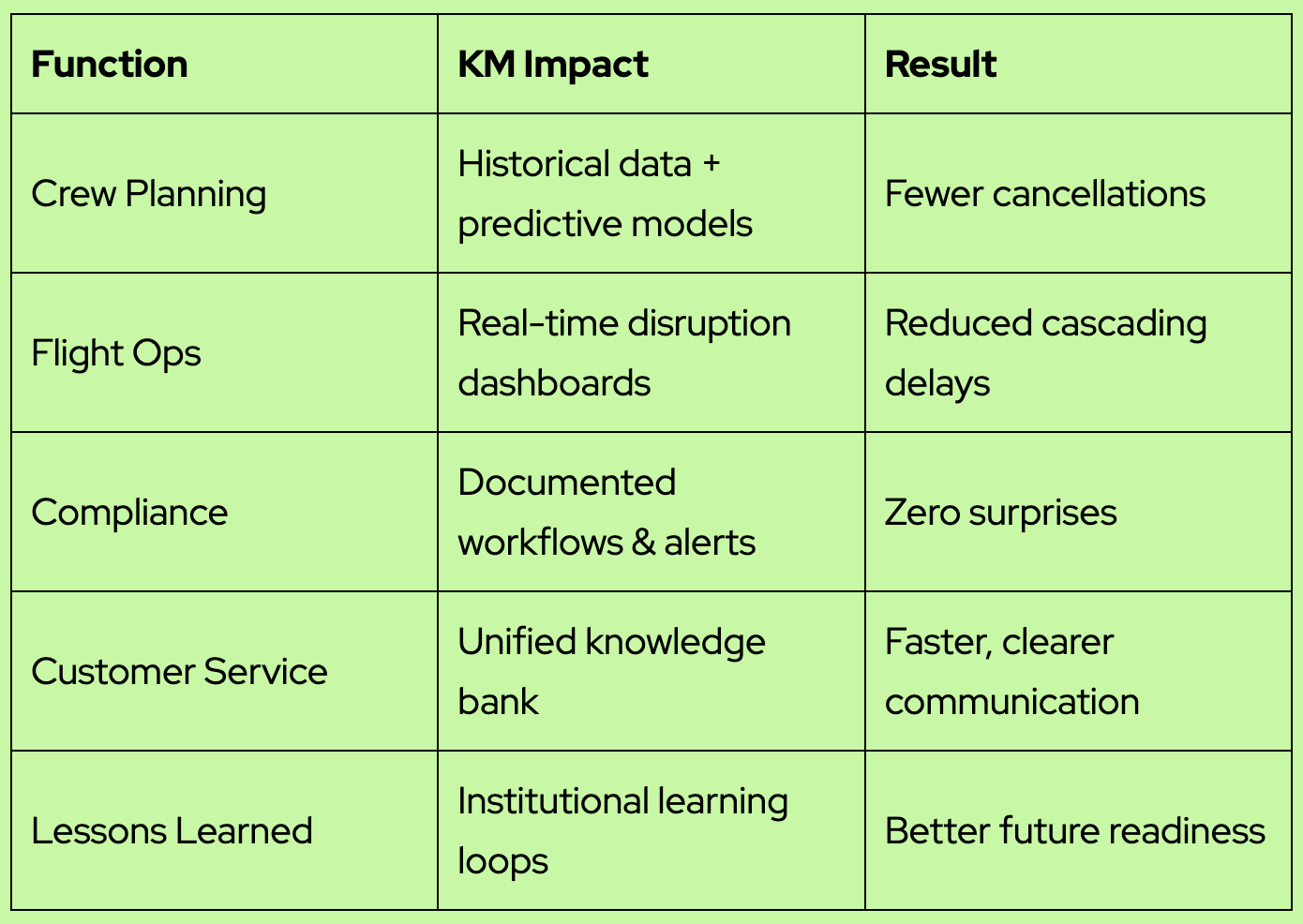
As I tried to cope with the inconvenience, the parallels became clear:
This wasn’t just an operational failure — this was a Knowledge Management failure.
When KM is weak, even predictable events turn into crises. When KM is strong:
- Forecasting is accurate
- Communication is proactive
- Teams stay aligned
- Customers trust the system
Aviation is too complex to operate without a robust KM backbone.
And this experience reminded me why KM isn’t just an internal capability — it directly shapes customer journeys, brand perception, and organisational resilience.
.jpeg)


.png)
.png)
.png)
.png)