Five Knowledge Management Myths I Still Hear Today
When people hear the term Knowledge Management (KM), reactions are often surprisingly similar. Some think it's about document repositories. Others assume it's a technology problem. And some believe it's something that's only relevant for large organisations.
After working in KM for several years, I've realised that many misconceptions still exist. Here are five KM myths I continue to hear and why I believe they're wrong.
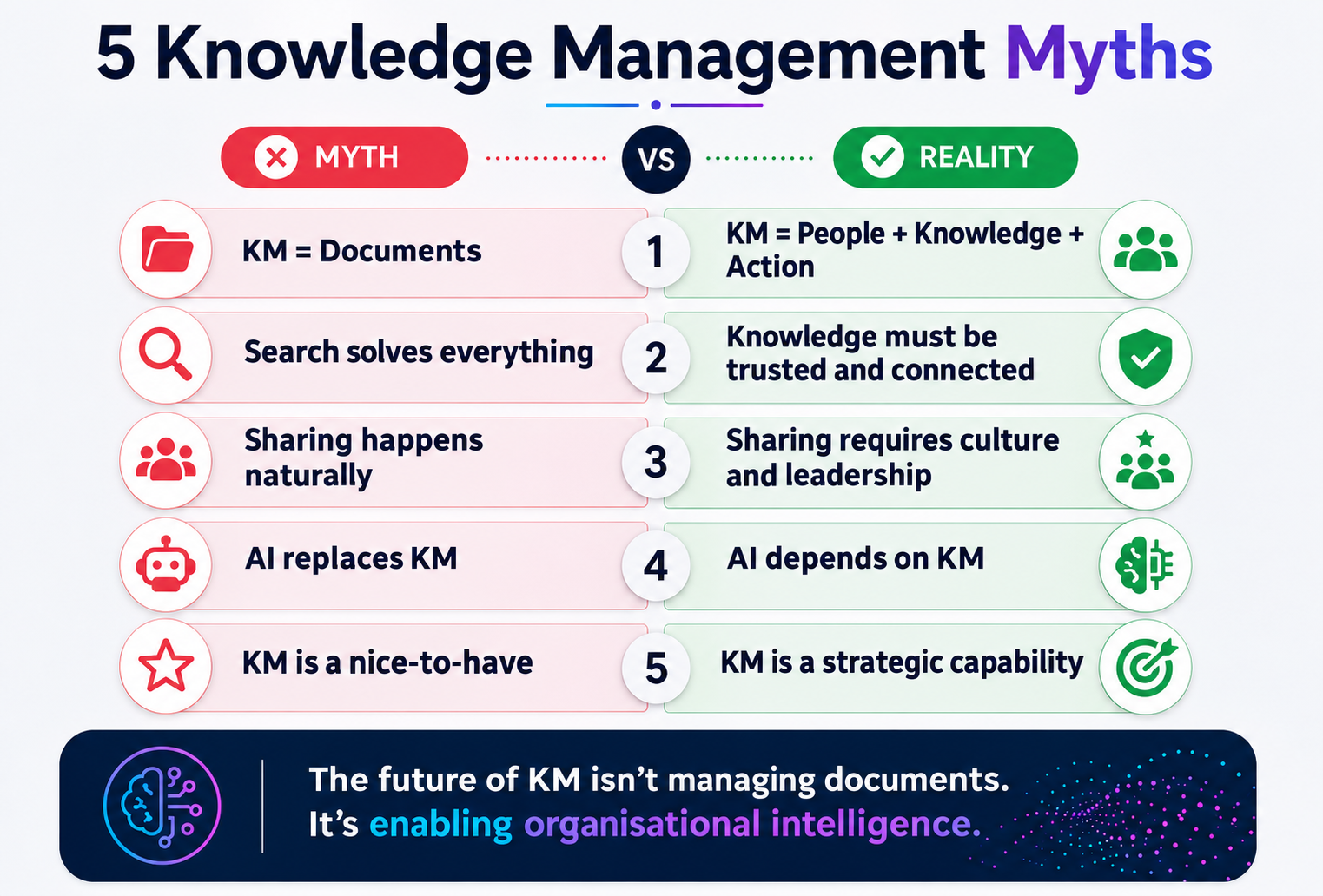
Myth #1: Knowledge Management Is Just About Documents
Documents are important. But KM is really about helping people find, share, and apply knowledge. Some of the most valuable knowledge doesn't live in a document at all. It lives in people's experiences, relationships, and lessons learned.
Myth #2: If We Have a Good Search Engine, We Don't Need KM
Technology can help people find information. But KM is about much more than search. It's about ensuring knowledge is trusted, current, connected, and meaningful. Finding outdated or conflicting information faster doesn't solve the problem.
Myth #3: Knowledge Sharing Happens Naturally
In theory, yes. In practice, not always.People are busy.
Teams work in silos. Expertise often remains hidden.Knowledge sharing requires intentional effort, supportive leadership, and a culture that encourages collaboration.
Myth #4: AI Will Replace Knowledge Management
This is one I've heard more frequently recently.My view is the opposite. AI is making KM more important than ever.AI depends on high-quality, accessible knowledge. Without it, AI cannot deliver reliable or valuable results.
Myth #5: Knowledge Management Is a "Nice to Have"
When organisations lose expertise, repeat mistakes, duplicate work, or struggle to find information, the impact is very real.
KM isn't just about managing knowledge. It's about improving how organisations learn, collaborate, innovate, and make decisions.Ultimately, I believe KM is evolving. It's no longer just about managing content.It's increasingly about enabling organisational intelligence. And that's why these misconceptions matter. Because when we reduce KM to documents or technology, we miss the much bigger opportunity.
Knowledge Management is not about managing knowledge. It's about enabling people and organisations to learn, adapt, and perform at their best.
______________________________